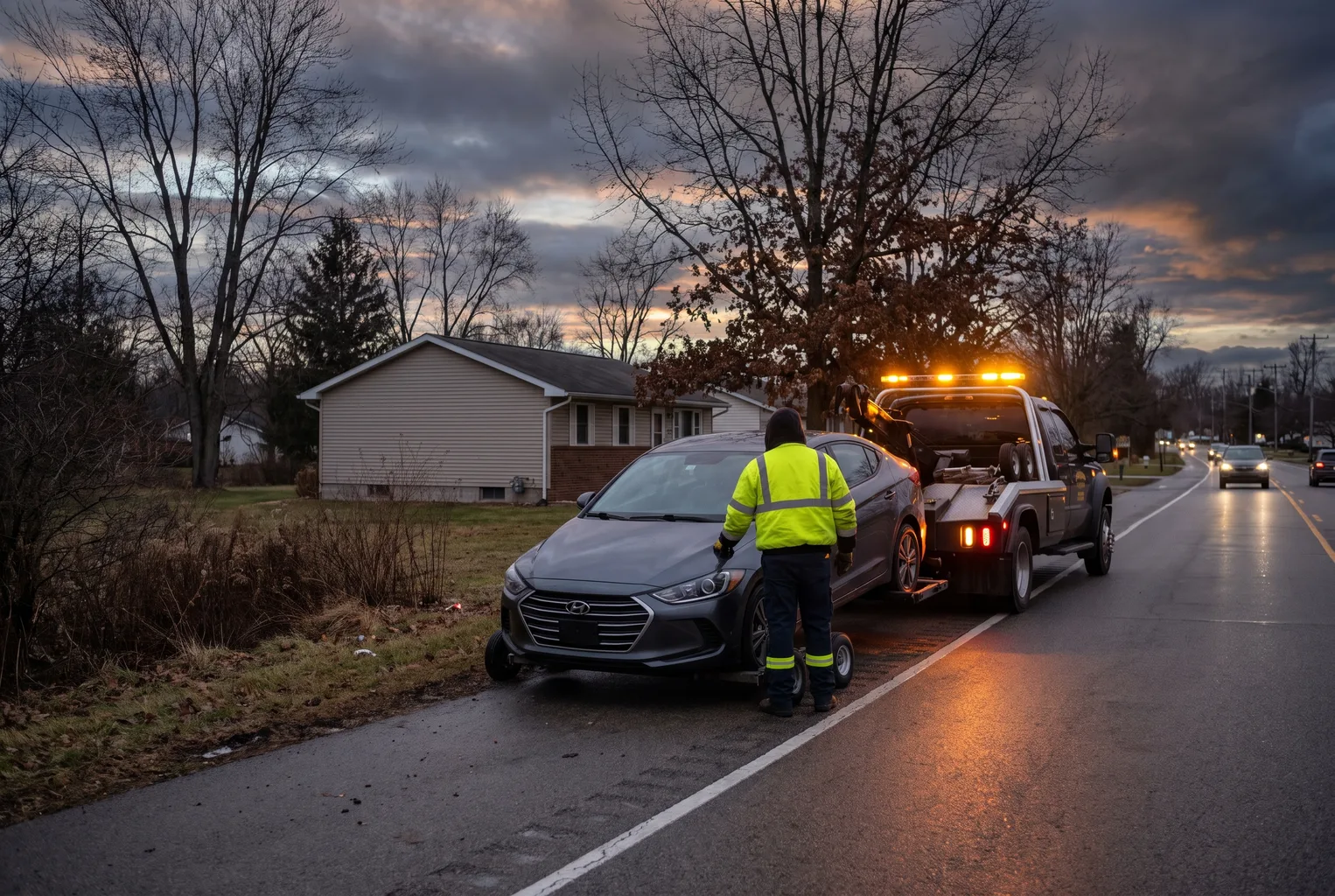
Emergency towing covers a vehicle that has stopped somewhere it cannot stay and cannot be driven any further under its own power. That happens after a collision, after a mechanical failure severe enough to make continued driving unsafe, or during an ordinary breakdown in traffic or on a highway shoulder. The work itself is straightforward in concept — moving the vehicle to a safe, agreed destination — but the situation around it rarely is. A vehicle stalled in a live traffic lane on the I-680 loop during evening commute carries different risks than the same vehicle stalled in a Boardman parking lot on a quiet Sunday, even though the tow itself may look similar once underway.
As the broadest towing category, emergency towing applies wherever a car, light truck, or SUV needs to leave a location it cannot safely remain in. It is usually the right starting point when a situation does not obviously fit a narrower category — a roadside fix, a flatbed-specific need, or a stuck-not-broken recovery. Describing what happened and where the vehicle is sitting is generally enough to sort out which category actually applies; emergency towing exists partly to cover the cases that do not sort themselves cleanly.
Fit for this service comes down to one distinction: can the vehicle be driven, even briefly and carefully, to reach help on its own? If not, some form of towing is needed, and emergency towing is the default category unless something about the vehicle — all-wheel drive, existing collision damage, low clearance — points toward flatbed transport instead, or unless the vehicle is stuck rather than mechanically disabled, which points toward a winch-out.
When seeking emergency towing, the most useful details are the vehicle's condition, its exact location, whether it is blocking traffic, and the destination if one is known. Those details help distinguish a standard tow from flatbed transport or a recovery situation; timing, cost, and availability need to be confirmed directly rather than assumed from this page.
Afterward, the vehicle sits at whatever destination was agreed on — typically a repair facility, a residence, or another location the owner specifies. What happens to the vehicle from there, whether a diagnosis, a repair, or an insurance claim, is a separate matter handled by other parties; towing ends once the vehicle has safely reached its destination.
Across Youngstown and nearby Mahoning County communities — Boardman, Austintown, Struthers, Campbell, Poland, Canfield, and Girard — winter weather can change road and shoulder conditions. A vehicle disabled near downtown Youngstown or Youngstown State University presents different access details from one on a two-lane road outside Canfield, so the location should be included when requesting help.
What Emergency Towing Involves
- Passenger cars, light trucks, and SUVs that are not driveable
- Vehicles involved in a collision that need to be moved from the scene
- Vehicles stopped in a traffic lane, on a shoulder, or in a parking area
- Transport to a repair facility, a residence, or another destination confirmed with the owner
- Coordination with the vehicle owner on where the vehicle should go next
- Does not include the mechanical repair, body work, or insurance claims process itself
- Does not include long-term storage of the vehicle once it reaches its destination
When Emergency Towing Applies
- The vehicle won't start and the issue can't be resolved on the spot
- A collision has left the vehicle undriveable or unsafe to continue driving
- The vehicle has stopped in a traffic lane, on a shoulder, or in another location it can't remain
- A mechanical failure makes continuing to drive unsafe
- The vehicle needs to reach a repair shop and can't get there on its own
What Affects the Job
- Vehicle type, weight, and general condition
- Whether the vehicle can be moved on a wheel-lift tow or requires a flatbed
- Where the vehicle is located and how it can be safely reached
- Distance to the requested destination
- Traffic conditions, particularly along the I-680 loop during peak hours
- Weather and road surface conditions, which affect both access and safe loading
- Any collision damage that changes how the vehicle can be approached and secured
How an Emergency Tow Is Handled
- The vehicle's location, condition, and requested destination are confirmed
- The appropriate method — wheel-lift or flatbed — is determined from the vehicle's condition
- The vehicle is safely accessed, which may mean coordinating around traffic or road conditions
- The vehicle is loaded and secured for transport
- The vehicle is delivered to the confirmed destination
Emergency Towing vs. Related Services
- Roadside assistance may fit a vehicle that is otherwise driveable but has a flat tire with a usable spare, an empty tank, a dead battery, or keys locked inside
- Winch-out recovery fits a vehicle stuck in mud, snow, or a ditch when the main problem is traction or position rather than a mechanical failure
- Heavy-duty towing is the category to discuss for commercial trucks, buses, RVs, and equipment beyond passenger-vehicle towing needs
- Flatbed towing may be more appropriate when all-wheel drive, low clearance, or collision damage changes how the vehicle should be moved
Frequently Asked Questions
What counts as an emergency tow?
Any situation where a vehicle cannot be safely driven and needs to be moved from its current location — a breakdown, a collision, or a mechanical failure severe enough to make continued driving unsafe.
Where can the vehicle be towed to?
Typically a repair facility, a residence, or another destination confirmed with the vehicle owner once the situation is described.
Does emergency towing include the repair itself?
No. Towing covers transporting the vehicle to wherever it needs to go next. Any mechanical or body repair is a separate matter handled by a repair facility.
What if the vehicle is still sitting in a traffic lane on I-680?
If the vehicle is creating an immediate traffic hazard, contact 911 first. Emergency roadside or towing assistance must be arranged through a verified dispatch contact; the online quote/contact form is for non-urgent requests and does not initiate dispatch.
Related Services
- Roadside Assistance
On-the-spot help for common roadside problems that don't require a full tow — flat tires, fuel, dead batteries and lockouts.
Learn more - Flatbed Towing
Transporting a vehicle on a flatbed rather than towing it on its wheels, for vehicles that shouldn't be towed conventionally.
Learn more - Winch-Out & Vehicle Recovery
Pulling a vehicle back onto solid ground when it's stuck in mud, snow, or a ditch rather than mechanically disabled.
Learn more - Jump-Start & Lockout Service
Two common roadside situations — a dead battery and keys locked inside a vehicle — handled without a tow.
Learn more
Ready to Discuss Your Project?
Review the available services and prepare the basic details of your project to request an estimate.