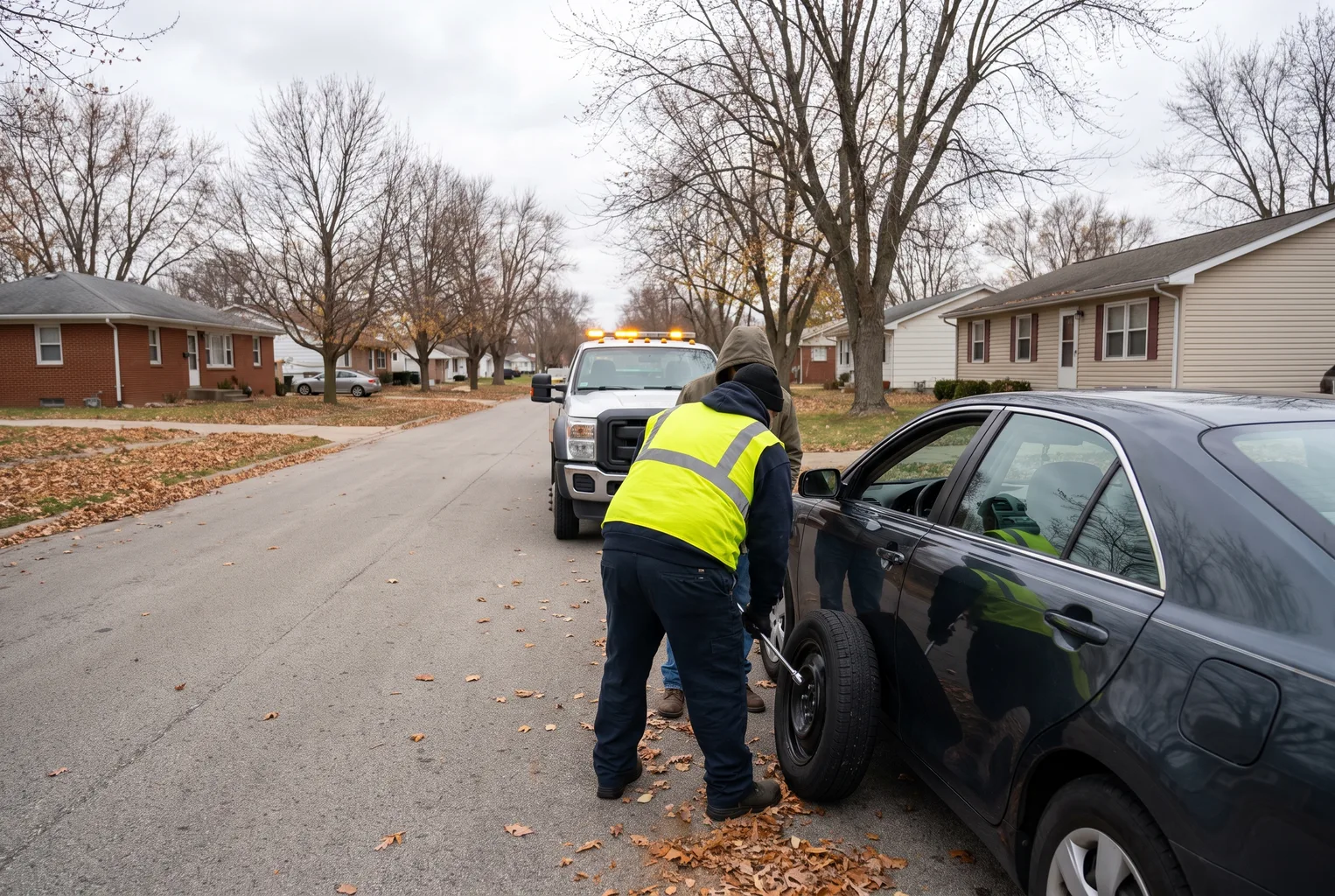
Roadside assistance covers the situations where a vehicle can be gotten moving again without being towed at all. A flat tire, an empty fuel tank, a dead battery, and keys locked inside the vehicle are common enough that most drivers encounter at least one of them, and each can typically be resolved where the vehicle already sits, rather than requiring the vehicle to be moved anywhere.
This is a distinct service from towing, not a smaller version of it. The distinction matters for fit: roadside assistance is the right category when the underlying vehicle is otherwise sound and the problem is a single, identifiable issue — a tire, a battery, fuel, a lockout — rather than a broader mechanical failure or collision damage. If the on-site fix does not resolve the problem, the situation may then need to be handled as a tow instead, which is a separate step rather than an automatic escalation.
Fit also depends on what tools the situation allows. A tire change requires a usable spare; without one, a flat becomes a towing matter rather than a roadside fix. A jump-start assumes the battery itself is capable of holding a charge once started; a battery that will not hold one is not resolved by roadside assistance alone, even though the visit may still confirm that diagnosis before anything further is decided.
When seeking roadside help, say whether the issue is a tire, fuel, battery, or lockout, and mention anything that affects access. A tire change depends on a usable spare, and a roadside visit does not replace a broader mechanical inspection. If the immediate issue does not leave the vehicle safely driveable, towing may be the next category to discuss.
Limitations follow from the same logic. Roadside assistance does not include tire repair — only a change to the spare already present — and it does not include battery replacement, part replacement, or a mechanical diagnosis beyond confirming whether the immediate issue is resolved. Those are separate services, typically handled by a repair shop once the vehicle is moving again.
After a tire change, fuel delivery, jump-start, or lockout, confirm that the vehicle can be driven safely before leaving the location. A low spare or a battery that will not hold a charge may still require a tow or repair-shop visit.
Cold weather in Northeast Ohio can strain a marginal battery, while lockouts and flat tires can happen in any season. A roadside issue near Youngstown State University or downtown Youngstown may have different access details from one on a rural stretch outside Poland or Canfield, so the location belongs in the request.
Useful tire information includes which wheel is affected, whether the spare is present, and whether the wheel or tire appears damaged beyond a simple loss of air. For a fuel request, identify the vehicle and fuel type rather than assuming gasoline and diesel can be handled interchangeably. These details help separate an ordinary roadside request from a situation that needs transport or another specialist.
Access also changes the conversation. A vehicle in a parking garage, behind a locked gate, or beside a narrow shoulder may need different arrangements from one in an open driveway. Describe where it sits without entering traffic or putting anyone at risk to gather extra information; immediate hazards belong with emergency services.
What Roadside Assistance Involves
- Flat-tire changes using the vehicle's own spare
- Fuel delivery when a vehicle has run out of gas
- Battery jump-starts
- Lockout service when keys are locked inside the vehicle
- Confirming whether the on-site fix has resolved the issue before ending the visit
- Does not include tire repair, part replacement, or a broader mechanical diagnosis
- Does not include battery replacement
- Whether more than one issue is present at once, since a flat tire and a dead battery occasionally turn up together
When Roadside Assistance Applies
- A tire has gone flat and a usable spare is available
- The vehicle has run out of fuel
- The battery is dead but the vehicle is otherwise able to run once started
- Keys are locked inside the vehicle
What Affects the Job
- Which specific issue is involved — tire, fuel, battery, or lockout
- Whether a usable spare tire is actually present
- Vehicle location and access to the affected wheel, fuel port, or door
- Battery condition, which determines whether a jump is likely to resolve the issue
- Whether the issue turns out to need more than an on-site fix
- Time of year, since cold-weather months increase the share of calls involving batteries specifically
How a Roadside Call Is Handled
- The specific issue is confirmed before anything is dispatched
- The vehicle's location and any access considerations are noted
- The appropriate fix is carried out on site
- The result is confirmed before the visit is considered complete
- If the issue cannot be resolved roadside, next steps are discussed directly with the owner
Roadside Assistance vs. Towing
- Roadside assistance fits a single on-site issue when the vehicle can be safely driven after that issue is addressed
- Emergency towing is the next category when a roadside step does not leave the vehicle safe to drive or the vehicle needs transport to another location
- Winch-out recovery, rather than roadside assistance, is relevant when the vehicle is stuck in mud, snow, or a ditch
Frequently Asked Questions
What is the difference between roadside assistance and towing?
Roadside assistance resolves the issue where the vehicle sits. Towing moves the vehicle elsewhere because it cannot be driven.
What if there is no spare tire?
A tire change requires a usable spare. Without one, the situation is typically handled as a tow to a repair facility instead.
Can a jump-start always get a dead battery running again?
Not always. Some batteries will not hold a charge even after a jump. If that happens, towing to a shop is usually the next step.
Does roadside assistance include fixing a flat tire itself?
No. The service changes the flat for the vehicle's spare. Repairing or replacing the tire is a separate matter handled by a tire shop.
Ready to Discuss Your Project?
Review the available services and prepare the basic details of your project to request an estimate.